Invest in your tech career with a full day of learning & networking. Held at the weekend so you don't have to ask for time off work.
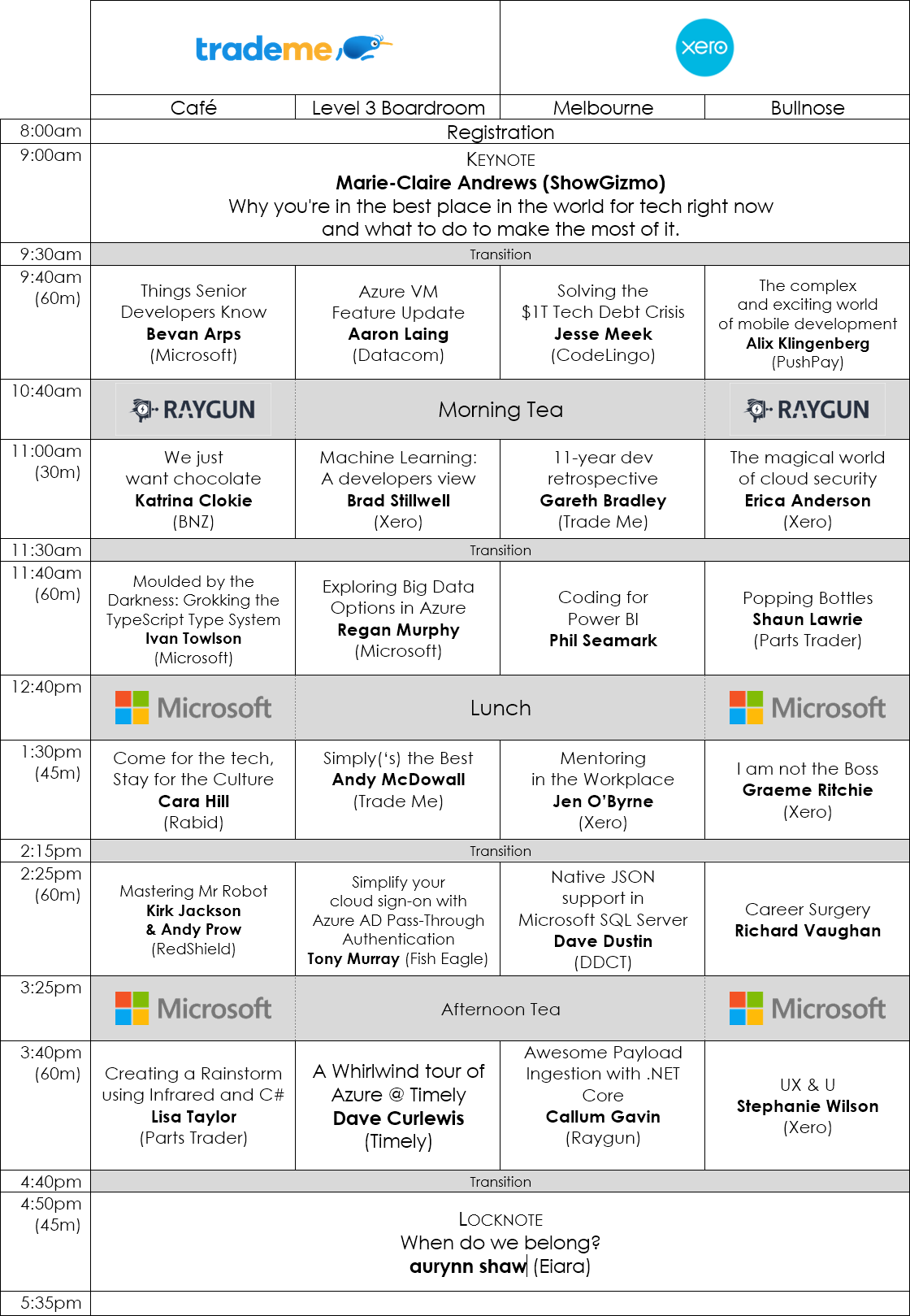
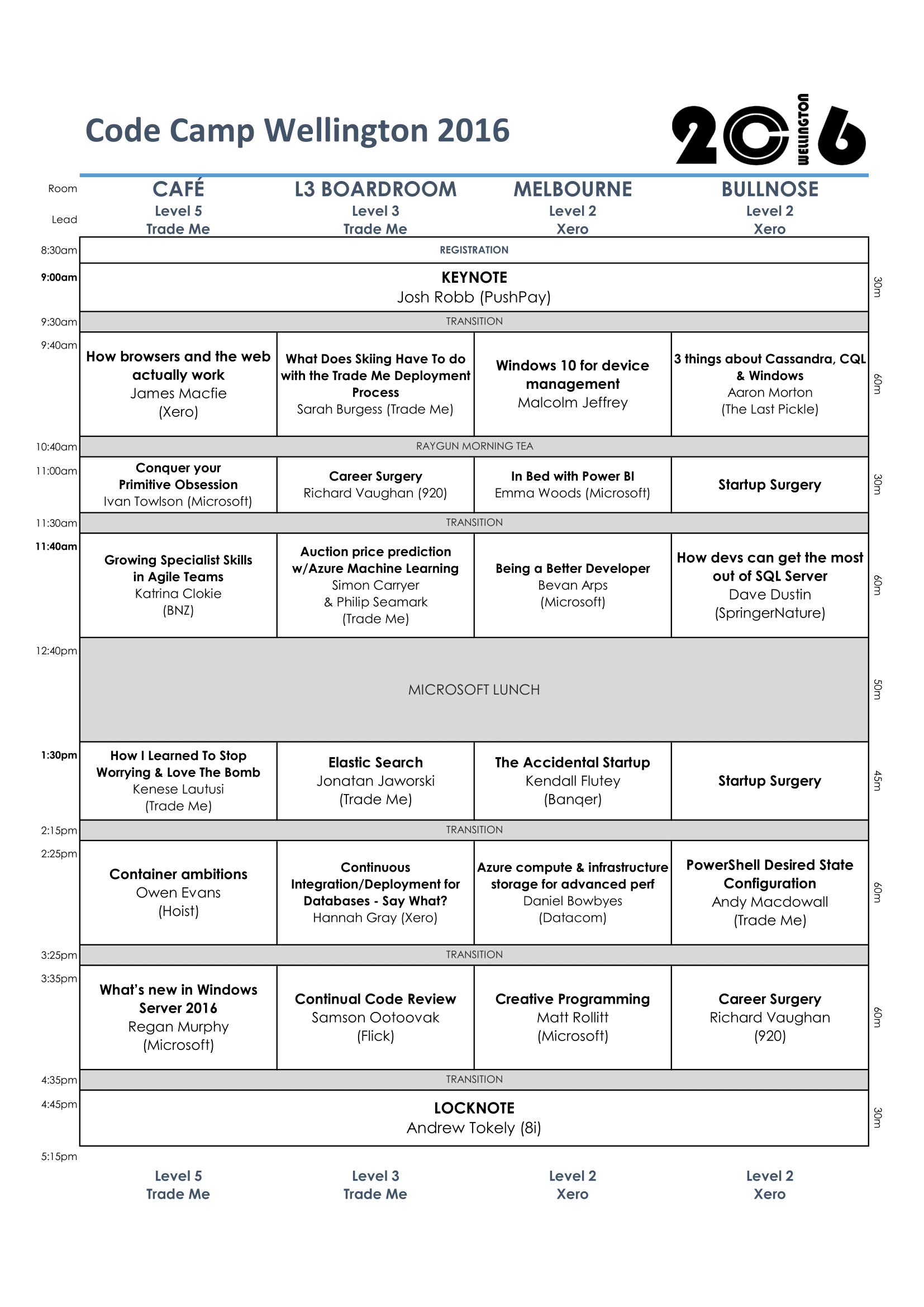
Hear from Wellington's finest new talent and some of New Zealand's best technical speakers. Check out our programmes from 2016, 2017, 2018, 2019, 2020, 2023, 2024, and 2026.
Something for everyone, with presentations on the latest hot technologies, developing your career, and everything in-between.
Our tickets are free. Yes, free.
That's right, no charge.
We want everyone to be able to come.
A free one day Tech Conference organised by a team of volunteers for the benefit of the Wellington Tech community.
We'll have speakers across multiple subject tracks; you can leave your laptop at home.
We thank these major sponsors for their support of Code Camp Wellington 2026


We thank these sponsors for their support of Code Camp Wellington 2026
How do you keep that startup mindset alive, even after your company has grown so much, after you've been around for over 23 years? This is a challenge, but not an insurmountable one,
Startup mentality is full of innovation, laughter, energy, productivity and the kind
of creative chaos which drives new businesses to succeed.
So how the hell do you keep this kind of startup momentum alive in your company, even after it's grown so large that it spans both NZ and the US? A company that's been around for a long time?
As one of the founders and the Head of architecture of PartsTrader, I'll give a talk on exactly that. What allows you to grow in scale but keep that startup energy and enthusiasm running hot (well, as hot as you can) so that you get the best of both worlds: incremental success and growth, coupled with the innovation and fun of a startup's madness.
Native San Franciscan gone immigrant to New Zealand. Author, software weirdo, martial artist, entrepreneur and all that jazz. Wants out of the rat race so he can be a full time writer/gardener/designer/chef/madman Among other things, Chris has been working software and solution architecture for PartsTrader since its inception.
The idea is to share highlights of my testing career journey from where I started to where I am right now. It showcases that testing is not merely a task that you tick in the box, instead, it is holistic, influenced by colleagues, industry, community, culture, technology, trend,
experience, revolving around the essence of quality. The takeaway I would love to give, is inspiration and encouragement to how quality should be cared for in the industry, which is not solely the responsibility of the testing experts, instead, should be championed by them.
He has over a decade of experience in software testing, working across industries including gaming, mobile and web applications, banking, and automotive procurement. His expertise covers test strategy, automation, and data quality, with a focus on building reliable and scalable testing practices. Throughout his career, he has led and mentored testing professionals and supported teams in improving their ways of working, fostering collaboration and continuous improvement. He previously had the privilege of speaking at a software testing conference in the Philippines, reflecting his ongoing passion for contributing to the testing community. He currently works with a team of talented data engineers and data specialists, focusing on ensuring quality in modern, data-driven systems.
Most of us are used to pressing F5 and running a single service locally.
But modern applications are distributed systems — and they’re increasingly polyglot.
In this session, I’ll share my recent hands-on experience using Aspire in a real project, and how
it changed the way I think about local development for cloud-native applications — even beyond the .NET ecosystem.
We’ll explore how Aspire simplifies running and wiring multiple services, managing dependencies, and getting observability out of the box. While Aspire started in the .NET world, it now also supports non-.NET workloads such as Python, making it a compelling option for teams building mixed-stack systems.
I’ll walk through practical examples, live demos, and the lessons learned along the way — including what Aspire does well, where it falls short, and when it may not be the right fit.
If you’ve ever struggled to make your local development environment feel closer to production, this talk will give you a fresh and realistic perspective on what’s possible with Aspire today.
15+ years' experience with .NET platform. Focus on .NET, C#, ASP.NET, .NET Core, etc.
Can you fix a real-world bug on a large SaaS app while out and about running the hills of Wellington? A fun experiment how far you can take agentic coding by talking rather than typing.
B2B SaaS'er at Runn. Infosec nerd. GraphQL tragic. Occasional slop connoisseur. Aspiring agent overlord. Proud Silverstripe alumni. Still thinks MVC and Active Record are great design patterns.
AI makes me faster, but "waiting for AI" isn't real waiting. While it processes, I jump to chats, PRs, and new prompts to meet the new productivity standards. Output rises, but so does context switching and mental load. This talk highlights the new norms for AI-assisted day-to-day development life and the hidden cost of AI-driven work.
A developer by accident, I started my career in France, now call New Zealand home, and work fully remote for an Australian company.
Session to talk about how at Airie we're leveraging the capabilities provided by AI to gather, fine tune and add value to large unstructured data sets as they relate to immigration.
The focus will be on "real world" experience with fine tuning our own models in the Azure
AI foundry and applying to real-world use cases.
We'll also be covering leveraging the power of Claude Code to develop our own custom agent orchestration platform and how we can monitor and correct the results of the AI models in real-time. Can't wait to share what we've been working on!
Career software developer for over 25 years. Currently working as a solution architect and tech-lead for Airie, a start up focused on making Immigration clearer, fairer and better.
Many developers learn little to nothing about digital accessibility in school or bootcamps. When it does come up later, it can feel unclear where to start or like you suddenly need to learn everything overnight.
In reality, accessibility is not about knowing everything
at once. It is about developing good judgement over time.
This talk explores a more sustainable way for developers to approach accessibility. Rather than memorising dozens of rules, we focus on recognising patterns, asking better questions and understanding how people interact with UI. Approached this way, accessibility fits naturally into everyday development work and often leads to higher quality code overall.
This session is for developers at any stage of their accessibility learning journey, whether you are encountering it for the first time or have started exploring it but feel overwhelmed. Attendees will leave with a clearer mental model for accessibility, practical ways to think about it during development and confidence that they can make better decisions without needing to be experts.
Maia is the Managing Director of Aleph Accessibility. An IAAP-certified web accessibility specialist, she brings a wealth of technical expertise and accessibility knowledge to the table. Maia has an innate ability to translate complex concepts into clear and easily digestible content. Her contagious enthusiasm for web accessibility is combined with a pragmatic, down-to-earth approach to software development, providing audiences with practical strategies for successfully embedding accessibility into their digital products.
As developers, we have a responsibility to keep the data of our company and our users safe, secure and private. The cybersecurity domain is vast, and the threats are ever-changing and as developers we have features to deliver and deadlines to meet, and a whole host of other concerns
and tradeoffs to juggle.
Short of retraining as cybersecurity professionals, how can we as Python developers do our part to help keep ourselves, our customers and our data safe? In this talk, we'll look at the ways developers commonly fall short, and just how simple it can be to drastically reduce the "oops factor" of our Python development lifecycle through automation and tooling.
Formerly an engineer at Trade Me, Simon is a Senior SRE experienced in building and securing cloud native software and infrastructure in the Payments Industry. His passion is the intersection of technological and interpersonal challenges of getting code from commit to production, safely, securely and on demand - especially in regulated sectors such as Payments.
I've been writing Elixir for over 10 years, and have consistently seen teams deliver software to a higher degree of quality, at a higher rate of speed, and at significantly lower cost to build and to operate than with any other toolchain. Elixir is still a "niche" language, and
lacks the centralized corporate backing that many other ecosystems have. Without the same community mass and financial backing, how is it possible for Elixir to be so productive and effective?
As a framework author, I often deal with high level abstractions and business logic. In this talk, however, we will peel back the covers to illustrate the small design choices underpinning the Elixir programming language that manifest in exponentially more efficient and understandable applications. Together, we will see how the core design choices in any system are multiplied and magnified when we build on top of them.
Most importantly, we will come to understand the fundamental reason that Elixir manages to be so productive and effective: We aren't building on sand.
James Harton is a Principal Engineer at Alembic, creator of Beam Bots, and Ash core team member. He is the author of Reactor, Ash Authentication, and many other libraries in the Elixir ecosystem. Based in New Zealand, James has been building with Elixir for over a decade and has a particular interest in embedded systems and Nerves. When not writing Elixir, he's probably soldering something.
Abstract
What if we could have consistently productive technical conversations, with a competent and supportive colleague who was unbiased and helpful. A colleague who was a thought partner, to help you translate your natural thinking style into formats that land with
your audience, refine approaches to stay productive for your managers, and you never had to concern yourself with considering whether this partnership may create social friction.
I've spent my career navigating and negotiating the foibles of being a female in tech, a neurodivergent female in tech. I've recently discovered that AI tools offer something unexpected: a collaboration space free from the social friction, and subconscious biases of the office. And devoid of opportunities to commit career limiting social faux pas.
This talk shares some practical tips, techniques and insights into using AI as a thinking partner. Particularly valuable for detail orientated minds, working in environments that require high level summaries. What do these phrases Top Down and Bottom Up thinking mean anyway? And how we can do both?
I'll take you though an approach to wrangle "stream of consciousness" detailed thinking into structured outputs. Helping to bridge the gap between bottom up detailed thinking styles, and the top-down strategic communications that we're often asked to produce before the thinking is done. All in a way that supports different audiences, and won't create social friction.
This isn't about using agentic AI to improve coded outputs, productivity or AI coding weekend projects. No coding, no apps. This isn't about using AI to replace human collaboration, human insights, human ingenuity or human relationships. It's about having a tool that let's you think authentically, in your natural style, in a socially neutral way and translate it into effective outputs.
I'll cover why AI conversations can be refreshingly different from typical interactions.
A practical workflow for detailed orientated thinkers to skeleton outlines and polished outputs.
How to use "bracketed thinking" to increase your clarity.
How to ensure that you've got the top down world covered.
Whether you are neurodivergent detailed orientated yourself, or simply someone whose thinking style doesn't always match what is expected, this session offers some actionable techniques to be authentic, and leverage AI as a consistently supportive, unbiased and all round awesome colleague. Come learn how to leverage AI as the colleague who helps you show your best work, your way.
Target Audience: All levels, particularly valuable for neurodivergent professionals who think better in details.
Working in large enterprises for over twenty years, as a female in technology, with primarily male colleagues, I have a particular passion for considering the social cohesion and communication style differences in the work place. Tech driven. People centered.
In my previous Code Camp talk, "From Bytes to Bias," we explored how the GRU hacked the 2016 U.S. election to influence public opinion. But while one unit was hacking minds, another was hacking critical infrastructure.
Join Kade, CEO of Arachne Digital, as we dissect
the landmark 2020 indictment of six GRU officers from Unit 74455, better known to the world as Sandworm. Moving beyond election interference, this session exposes the operational details behind the most destructive cyberattacks in history.
This talk will analyze how Sandworm evolved from espionage to sabotage, employing "false flag" operations to mimic North Korean hackers and using custom malware to destabilise nations. Whether you are a developer, security pro, or threat intelligence enthusiast, you will leave with a clearer understanding of the modern cyber warfare landscape.
Kade is the CEO and co-founder of Arachne Digital. With nearly a decade of experience in the security industry, he holds a unique background in criminology and international relations. Kade specialises in the intersection of hacking and geopolitics, analysing how state-sponsored cyber operations impact the physical world.
AI-assisted coding is changing how we build software — faster, more exploratory, and often less deliberate. This talk looks at what happens when curiosity-driven “vibe coding” meets multi-agent workflows, MCP tooling, and A2A communication. We’ll explore emerging security and
privacy risks such as data leakage, model and prompt poisoning, insecure trust boundaries, and unsafe defaults, and discuss how developers can stay curious without accidentally shipping vulnerabilities.
Anna Lezhikova is a cyber security consultant based in Wellington, New Zealand. She combines her experience in sociology, business management, communications, and IT to help companies to run and grow their business securely in the digital age. Armed with a Master's degree in Sociology, an MBA, and a Diploma in Machine Learning and Artificial Intelligence, Anna's expertise is fortified by practical know-how as a full-stack and DevSecOps engineer. This unique blend equips her with the capability to see problems from different perspectives and come up with holistic solutions.
What happens when you move a massive, live SQL database to the cloud managed service? We migrated XeroDB to AWS RDS to optimize costs and performance, but the journey wasn't without its risks. I’ll break down our migration strategy, the difficulties we faced, and how we measured our wins.
Yuri, Engineer from Data Reliability Engineering team in Xero which focuses on architectural efficiency, seamless deployments, and high-availability systems. our work sits at the intersection of cost-optimization and platform resilience, ensuring Xero’s data tier evolves alongside its global scale.
Modern colour pickers (like those in Chrome and Safari) are visually deceptive and mathematically flawed. They overwhelm users with “choice paralysis” by presenting tens of thousands of indistinguishable “invisible” colours and duplicates that exist to smooth out gradients rather
than offer the user distinct choices.
This mismatch, along with a fiddly UI, forces users to rely on numerical tweaking (sliders and values) rather than visual manipulation.
As a consequence, choosing colours and refining colour choices for style, dark mode alternatives and accessibility is difficult. We tend to stick to the colours that we know and play it safe. The web is constantly being blamed for looking “all the same,” and I believe how we visualise our colour palettes plays a big role in this generalisation. In reality, colour is rich, subtle, visually fun and exciting.
In this visually rich lightning talk, I’ll show the flaws in our current tools and demo a live colour wheel alternative that improves the user’s experience by reducing choice and keeping it an entirely visual experience.
Maarten Idema is a Product Design Lead at Xero by day and a code-tinkering maker by night. With a Masters in Type and Media from the Netherlands and a background as a full-stack developer, Maarten sits comfortably at the intersection of design and engineering. He has spent the last 20 years building hybrid teams, lecturing, and building apps. He is most passionate about building tools and visualisations that reveal hidden insights
Some of the tech around us tends heavily towards convenience: reducing friction, reducing effort. But not all discomfort is bad. Some resistance and effort makes us stronger and more alive. Working out at the gym. Learning an instrument. Making new friends.
We'll go
through a few ways that friction can be good for us, the people around us, and the things we make. We'll also talk about how sometimes the friction isn't eliminated, it's just passed on to someone else, somewhere else.
Steve is a human-centred front-end developer and user experience designer. He helps software teams have happier customers by making more user-friendly and engaging software. He’s been building things for the web professionally since 2005 (and built things for fun for a while before that). Accessibility has been a part of his work for many years, but now it’s part of his job title too! He makes sites and apps that everyone can use, regardless of their device, the network they’re on, or any disabilities they may have.
Ready to move beyond Senior but not into management ? This session demystifies the path to Staff Engineer. We set out a practical framework for aspiring Staff engineers, and current ones. Learn how to demonstrate Staff-level impact in your role, and how to increase your impact as Staff+.
Thong Kuah is a Principal Engineer at GitLab and a former Tech Lead at Flux Federation. He specializes in shaping technical strategy and mentoring senior engineers to help them grow their influence and impact beyond a single team.
According to surveys, Svelte is one of the most-liked JavaScript frameworks out there. The uptake in the industry has been slow, yet steady. It is an open and community-driven project, built on some strong principles of:
- Simplicity
- Efficiency
- Compiler-framework,
as opposed to library framework
- Good DevEx
Our team successfully delivered a new front-end web app built with Svelte 5, Tailwind, and Typescript using an MVVM architecture with good test coverage. The session introduces these (and more) tech choices in creating a lean workflow and achieving good DevEx. An unintended bonus from these tech choices was the compounding benefit of using AI-assistance.
Session includes some code samples, lessons learned, and lots of interactivity (so bring along all your questions.)
Moiz feels the Internet can be more mindful and friendlier to not just the end-users but also the developers and adopt more lean principles. He has worked in various roles including front-end development, product management, consulting, research (in Human-Computer Interaction), and teaching. He also organises the monthly TED-Style Talks and, if he has any free time left, enjoys some photography, badminton, and squash. You can watch the demo of his PhD thesis prototype here: https://www.youtube.com/watch?v=EzyYsQoKb-k
Common practice for building web applications has become the SPA + API architecture. For many applications this is unnecessary.
Using examples and demos of real world applications, I will show how HTMX works and how it gives you a SPA experience without the overhead.
I have worked in software development for almost 30 years across a broad range of industries from b2b to e-commerce to legal to healthcare. I am currently an engineering lead at Lunit International helping guide a number of technical projects. I am passionate about emerging technologies particularly those that lead to an enjoyable developer experience.
Users must be able to quickly find information on your website quickly and reliably. Typesense is a website search engine that offers a search-as-you-type experience across millions of records nearly instantaneously. It is a blazing fast, type-tolerant, in-memory search application
that will dazzle your end-users and provide a delightful search experience. In this talk, I will dive into Typesense and show you how to connect it to a Silverstripe website.
Elliot is a Senior PHP Developer at Trade Me in Wellington with over 20 years in PHP, specializing in authentication, security, payment processing, and performance optimization. As a Silverstripe expert, he’s worked across multiple diverse fields, including education, government, and e-commerce.
By the end of 2024, I had spent over a decade as a passionate software engineer… and was deep into my third burnout. I had enough. I reflected upon the reasons, budgeted for the exit, and planned for a break in 2025. Eight months later, I returned to coding full time with a new
set of guiding principles.
No regrets. Here’s what I did to recognise when to stop, rest, and prepare for the next phase of my career.
I'm a UX Engineer, on a mission to help people create more accessible web experiences. I speak regularly about crafting user interactions, playing nice with other disciplines, growing front-end capabilities, and general career development. In my free time, I practice Kyudo (Japanese archery), and check out local eateries in Wellington.
Technical skill alone does not determine the trajectory of a career—leadership does. In this talk, I share my own journey of working under poor leadership that stalled growth and confidence, followed by the experience of strong leadership that challenged me, supported me, and
fundamentally changed my career direction.
Using these contrasting experiences, I’ll unpack the specific leadership behaviours that quietly damage teams—unclear expectations, lack of trust, avoidance of accountability—and the behaviours that enable teams to rise: clarity, psychological safety, honest feedback, and real ownership. I’ll also reflect on how these lessons now shape the way I lead innovation teams in banking.
This is a practical, experience-driven session focused on how leadership decisions show up in day-to-day engineering work, how they impact careers over time, and how individuals can contribute to healthier, higher-performing teams—regardless of title.
Key Takeaways:
1. How leadership behaviours directly influence career growth and team outcomes
2. Early signals of leadership that causes teams to stall or break
3. What strong leaders do differently to unlock trust, ownership, and delivery
4. How engineers can build influence and resilience—even without formal authority
5. Leadership lessons I apply today while leading innovation teams
Audience:
Engineers, senior engineers, tech leads, and managers who want to grow their impact and help teams succeed sustainably.
I’m Mehuli Mukherjee, a Senior Software Developer at the Bank of New Zealand with over 11 years of experience in full-stack development. I’m leading the innovation projects in open banking, customer analytics, and AI-powered solutions, and I’m the creator of ExtractPDF4J, an open-source Java library for PDF table extraction. I’m deeply passionate about AI, Blockchain, and open source contributions.
Learn 3 key insights to take control of the job seaking process to help you secure your next dream role.
Joel Norris knows tech recruitment isn't just about filling roles - it's about getting the right people into the right places at the right time. Based in Wellington, he works with organisations across New Zealand that are hiring, scaling, and transforming, helping leadership teams secure talent across Software Engineering, Data, AI, DevOps, Infrastructure, and Cybersecurity. With a focus on building genuine partnerships, Joel helps tech teams scale high-performing functions, establish new capability, and solve complex hiring challenges - including tracking down those hard-to-find skillsets. He combines real market knowledge, salary benchmarking and an extensive tech network with a tailored approach that's built around each organisation's specific needs. At the heart of Joel's work is a simple belief: recruitment is fundamentally about trust. That means honest communication, meaningful feedback and a commitment to relationships that extend well beyond the placement. Outside of work, Joel can be found on Wellington's mountain bike trails, chasing snow on the ski slopes, or loudly backing the Broncos (yes, he's a Brisbane boy!) or hanging with his young family. He brings that same energy and dedication to every client and candidate he works with.
“The Developer's Guide to Delivering the Right Thing — Not Just the Built Thing” explores how developers can amplify their impact by shifting from simply shipping features to truly delivering customer and business value. This talk reframes developers as more than coders—they are
problem-solvers, product thinkers, and key contributors to strategic outcomes. By understanding the real problem behind a requirement, challenging assumptions, engaging in discovery, and focusing on outcomes over outputs, developers can reduce waste, improve quality, and create software that users genuinely love. It’s a practical, inspiring session designed to elevate engineering influence and help teams build the right thing, not just the requested thing.
Andy Wong began his career as a software developer before progressing into leadership roles across technology delivery. With a strong passion for empowering teams, Andy focuses on enabling product and engineering groups to deliver impactful outcomes with clarity, efficiency, and long-term sustainability. He brings a blend of technical depth and people-centric leadership, helping teams grow, collaborate, and consistently deliver work that truly matters.
This talk is about personal branding as a software engineer and how to get started.
In my final year of university, I started making videos on YouTube about my life as a computer science student, sharing tips and advice along the way. This then transitioned into sharing
about my life as a software engineer when I started working.
My "why" is to encourage women and women of colour to pursue a career in tech. Hopefully through sharing my thoughts and lessons learnt, others may resonate with it and feel inspired in their own journey, much like how I was inspired by other women in tech creators when I first started mine.
Along the way, this act of putting myself out there (regardless of how scary it is for me as an introvert!) unlocked a world of opportunities for me. I got to collaborate with other tech creators, speak at a Girls Who Code event at UC Davis, and discover so many other talented people in tech who are sharing their journey and work on the Internet. They've introduced me to realms of tech I didn't even know existed and inspired me. I even got the chance to meet up with some of them in person!
Content creation introduced me to cool people in tech, expanded how I think about my career, and created opportunities I never planned for. I'll share tips on how to get started and different ways to do it (because yes not all involve filming yourself!).
Magdeline Huang is a software engineer and content creator passionate about the intersection of tech and creativity. With over four years of experience building SaaS platforms for startups, she currently works at Runn, a NZ startup focused on people-first resource management. She graduated with a BSc in Computer Science and Entrepreneurship from the University of Otago. Passionate about closing the gender gap in tech, she shares her journey as a woman in tech on YouTube (20K+ subscribers), from day-in-the-life content to project walkthroughs and career lessons.
Most developers would use Go, Node.js or just Bash when they need to write a CLI tool. Equally, when developers think of Dart, they usually picture Flutter apps running on phones and tablets.
What if we merged these worlds and tried to build CLI apps with Dart? Could
that even be done?
In this session, we'll explore how to use Dart to build maintainable command-line interfaces that feel as polished as tools written in more commonly used CLI tech stacks.
We'll walk through the complete journey of building a CLI application - from initial project setup to distributing compiled binaries across multiple platforms.
The talk will use real examples from public and internal production tools like Raygun CLI and you'll learn useful patterns for argument parsing, modular command architecture, HTTP client management, file interactions and error handling. We know they work because we've been using these tools in the field for multiple years now.
By the end of this talk, you'll have a good foundation for creating your own CLI tools that take advantage of all the features we enjoy in Dart: type safety, good tooling and cross-platform compilation capabilities.
Whether you're automating with CI/CD, building developer tools or creating utilities for your team, you'll discover why Dart might be the great choice for your next command-line project.
Topics covered:
- Project setup and architecture for CLI applications with Dart
- Essential packages and patterns
- Adding production-grade features like help, logging and error handling
- Cross-platform packaging, distribution and deployment for CLI apps
- A real-world implementation: Raygun CLI
Software Architect and Engineering Lead with 20+ years building and scaling web and mobile platforms. I specialise in JVM-based backend systems, mobile development (Android, Flutter), and the architecture that connects them. Most recently, I led the architectural transition of a global online dating platform from legacy monoliths to .NET microservices with React frontends, while continuing to operate the existing JVM-based API platform serving over 1 billion interactions per month. I also introduced an AI-assisted software engineering program, integrating tools like Cursor and AI agents into team workflows. I lead distributed engineering teams, own DevOps pipelines, and bridge the gap between product strategy and technical execution. My work spans hands-on development, system design, and team leadership, often all three simultaneously. I'm equally comfortable debugging a race condition in production, designing a multi-region deployment strategy, or mentoring engineers through a complex refactor. I run my consulting practice through Ventego Creative, which has allowed me to work with organisations ranging from startups to enterprises including Vodafone, Citibank, Siemens, Cupid Media, Raygun, and DistroKid. I also maintain several open-source SDKs (Android, Flutter, Ruby, Python, Node) for Raygun's error tracking platform. Beyond client work, I'm an active conference speaker (Droidcon, Android Makers, CFCamp, and others), a technology writer for European IT publications, and have been co-organising community meetup groups since the start of my career. I hold a Master's degree in Mathematics and Computer Science and am currently pursuing a Master's in Data Science.
GenAI is already being used in everyday coding workflows — but many teams are adopting it without a clear mental model for when it helps, when it hurts, and who remains responsible.
This talk is for software developers and technical leaders who are using — or being
asked to use — GenAI in day-to-day coding, design, and review work. Rather than treating GenAI as a junior engineer or autonomous system, the session frames it as a reasoning tool whose value depends on how humans constrain, interpret, and remain accountable for its output.
With the right framing, GenAI can accelerate learning, exploration, and problem-solving. With the wrong one, it can amplify misunderstanding, create false confidence, and quietly erode architectural control. This talk explores where GenAI provides genuine leverage in coding work, where it introduces new risks, and why familiar delegation and automation models often break down.
Core themes
- GenAI as a reasoning tool rather than a replacement developer
- Where GenAI helps in coding and design — and where it creates risk
- Why responsibility and ownership become blurred in AI-assisted workflows
- Human-in-the-loop patterns and deliberate sequencing
What attendees will take away
- Practical rules of thumb for when to use GenAI in coding and design work — and when not to
- Patterns for keeping humans accountable in AI-assisted development
- Common failure modes to avoid when introducing GenAI into software teams
Roberto is the Manager of the Development Core team at MetService. A practitioner-leader based in Wellington, he focuses on AI-first modernisation of live software systems, where constraints, risk, and institutional trust matter. His work centres on integrating AI into software engineering in ways that preserve ownership, clarity, and architectural control. He is the originator of frameworks such as Micromanaged-Driven Development (MMDD) and MDSR (Moderniser), which explore how GenAI can support reasoning, sequencing, and decision-making rather than replace human judgment. Over more than two decades, Roberto has worked across multiple domains, including Python development — contributing to the Plone Foundation — mobile development, and cloud-based systems. He has spoken at international conferences including PyCon US, as well as events across South America, Europe, and New Zealand, including AWS Community Day Wellington, AWS Public Sector Day (2025), and Mobile Refresh.
Some developers just seem to fly when things get hectic — when bugs pop up, deadlines tighten, or priorities shift overnight. What’s their secret sauce? In this talk, I’ll share the habits, mindsets, and workflows that help you move fast without cutting corners or sacrificing
quality. You’ll learn how to shorten your debug loop, master your IDE, terminal tricks, and build a mental map of your team’s work to avoid reinventing the wheel. We’ll explore why sometimes slowing down to really understand a problem can actually speed you up, and how small automations and smart documentation can multiply your impact. Whether you’re at a scrappy startup or a big company, junior or senior, this session is for anyone who wants to get sharper, stay calm under pressure, and deliver better, faster.
Sam Jarman is a Kiwi engineering manager based in Sydney, Australia, with over 15 years of experience in software development. His background includes development and leadership roles in iOS, frontend, backend across startups, agencies, small businesses, and medtech. Sam currently leads a team of engineers at Cochlear, where he focuses on helping the team work efficiently and grow their skills.
There’s an old saying about not simply giving a person a fish, but instead taking the time to teach them how to fish. The problem is we often stop there. In complex systems, that still isn’t enough. The real multiplier is teaching people how to teach others how to fish.
At a time when technology increasingly rewards individual optimisation and personal success, this keynote asks a different question: how do we protect our ability to teach skills into the future while still pushing the boundaries of knowledge, in the same way previous generations did when they landed on the moon or unlocked atomic energy?
The answer lies in recognising that prosperity grows when more people are empowered to do their best. Capability scales when we design systems that teach widely, teach deliberately, and teach across generations.
This talk explores how capability actually scales (pun intended), and why individual expertise, no matter how impressive, rarely scales on its own. Drawing on years of travelling and teaching technical workshops with the Network Startup Resource Center (NSRC), a consistent pattern emerges. The further people are from easy access to technology, the greater the hunger to learn, build skills, and earn a place in that world. Where access is closer and more assumed, learning is more easily treated as optional, or quietly squandered.
From teacher training colleges in remote Bhutan, to Internet exchange points in Laos, to a computer science university in Myanmar where 90 percent of staff and students are women, the contexts differ dramatically. What connects them is not the tools, but the intent: education as a pathway to agency, resilience, and community.
Resilient systems don’t come from heroes, hand-offs, or clever fixes. They come from environments where knowledge spreads, judgement is shared, and people are trusted to pass capability on. Skills only endure when they can be taught across generations.
The goal of this session is to leave the audience energised and grounded, not because the future feels easy, but because they understand where real leverage lives: building people who can build people.
TBC
When most people think of a "game engine", they think of massive commercial game-creation toolkits like Unity or Unreal Engine. In this session, I'll walk through some history of game engines, the fundamentals of how and why they're built, and explore hobbyist-grade engine design - from drawing a triangle to fully interactive 3D scenes.
I've spent time as a full-stack engineer, an embedded systems developer, and a games programmer, and have now settled on being a cybersecurity person with many hobbies. I'm currently a Security Analyst at PartsTrader, working across application security and GRC.
Do you know what your next role looks like? Where do you want your career to take you? When your manager asks these sorts of questions, do you draw a blank? Let's spend some time together and ask ourselves thoughtful questions about what we value, what we're good at, and what our future looks like. This session is an opportunity to build your network, reflect, and articulate your ambition.
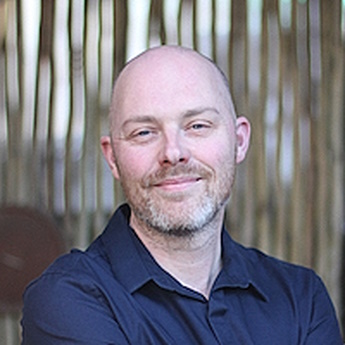
Katrina Clokie has spent the last two decades building a successful career as a leader of software engineering and product management teams, most recently spending two and a half years in a CTO/CPTO role. Katrina is well-known in the software testing community as the author of A Practical Guide to Testing in DevOps and is regularly invited to keynote at international conferences.

As a past presenter at Code Camp Wellington, Lisa shared insights into her unique journey of using code to create large-scale interactive art. She's always been drawn to problem-solving and has found joy in tackling unconventional challenges, from automating and streamlining processes to inventing novel solutions, such as using an Arduino to regularly water her plants. Now having forged a career in software development, she's driven by a passion to mentor and empower others. Her belief that "no problem can withstand the assault of sustained thinking" is at the core of her approach, hoping to inspire others to explore the seemingly endless opportunities in this industry. As a Engineering Manager at Lunit International, Lisa continues to use her expertise to guide the development processes and grow the development team to their full potential.
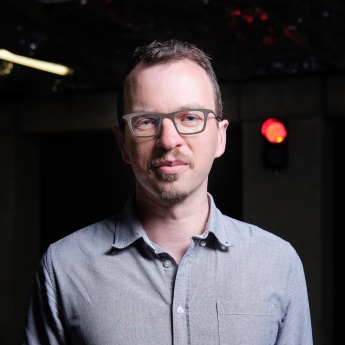
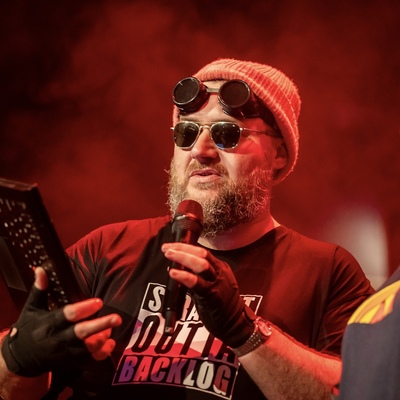
Gareth is a passionate speaker & organiser, with past involvement in communities covering software development (methodologies, Javascript/Angular, .NET), user experience, Toastmasters and internal corporate. He's here to help our speakers succeed - from those with a tentative idea, those new/new-ish to public speaking, to any range of past presentation experience.

Bio yet to be written.

Principal Engineer Data Reliability @ Xero. 40+ years consulting/developing/implementing. Not afraid to say "I don't know, let's find out".
An avid audiobook consumer, catch up coffee drinker, and lightning talk enthusiast, Oleg gravitates towards people who are deeply passionate and knowledgeable about almost any topic.By day he's an experienced contractor who got to wear many hats during his ≈20 years in software:
front end, UX, back end, architecture, burgers and devops.He can be seen around Wellington battling with API specs, wrangling pipelines, and debating the meaning of it all on a Friday afternoon.
Oleg welcomes your connections on LinkedIn mentioning you're from CCW!
❤️ Archie, Ella, Marisa
Our events are dedicated to providing a harassment-free experience for everyone, regardless of gender, gender identity and expression, age, sexual orientation, disability, physical appearance, body size, race, ethnicity, religion (or lack thereof), or technology choices.
We do not tolerate harassment of conference participants in any form. Sexual language and imagery is not appropriate for any of our venues, including talks, Twitter and other online media.
Participants asked to stop any harassing behavior are expected to comply immediately.
Participants violating these rules may be sanctioned or expelled from the event at the sole discretion of the organisers.